

Many of the properties we work in are new, contemporary buildings needing a little ‘softening’ with curves and timber; and we have worked in several historic homes that require a modern kitchen, sensitively designed to gently compliment the architecture. This project however, falls firmly between the two. A relatively new house located in woodland on a hillside close to the coast at Lyme Bay, it was built about 6 or 7 years ago with a traditional grandeur design. The clients bought the property from the original owner and immediately wanted to set about putting their own stamp on it. Looking for something very bespoke, their web search led them to us and of course we were happy to help.
The priority for improvement was the kitchen and adjoining utility room. Having a good sized utility room relieves some of the pressure from the design of a kitchen because there is no need to find homes for the washing machine and tumble dryer leaving more space for the culinary and social functions. The two rooms share a wall but due to the positioning of some of the services, there was an awkward space in the corner of the kitchen that had been disguised in the existing layout by simply squaring it off using cabinetry and then running the work surface into an alcove: a pragmatic solution but one that did not make best use of the space available. Simon loves finding innovative uses for awkward spaces and immediately saw the potential for creating something both beautiful and eminently useful – more of that later…

Another issue was that the kitchen itself was very dark. A sloping roof above a wall of windows and a glazed door had roof lights already fitted; but the light from these was prevented from reaching the rest of the kitchen by a structural ceiling beam that ran across the whole width of the room. There were two internal doors into the room: one from the utility room and the other, across the diagonal into the hallway. At Simon’s suggestion, the beam was raised up, smoothing the ceiling and allowing the light from the roof lights to reach the rest of the room; and a pair of Crittal-style glass doors was installed into the sitting room, allowing more borrowed light into the kitchen.
In order to make the room feel larger and more contemporary with cleaner lines, the cornices and covings were removed and the floor tiles replaced with large, light coloured square tiles. Despite all these changes to the fabric of the building, the services were able to stay in situ avoiding the need for complicated plumbing and electrical works. The result was a much lighter and airier room that could accommodate the colour scheme requested by the client.
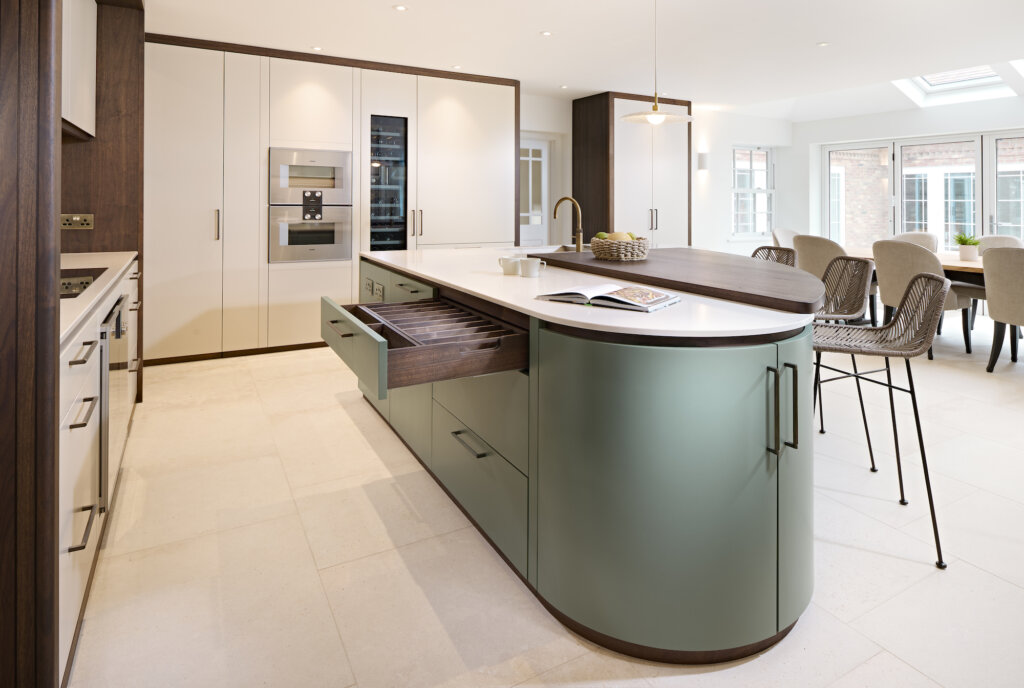
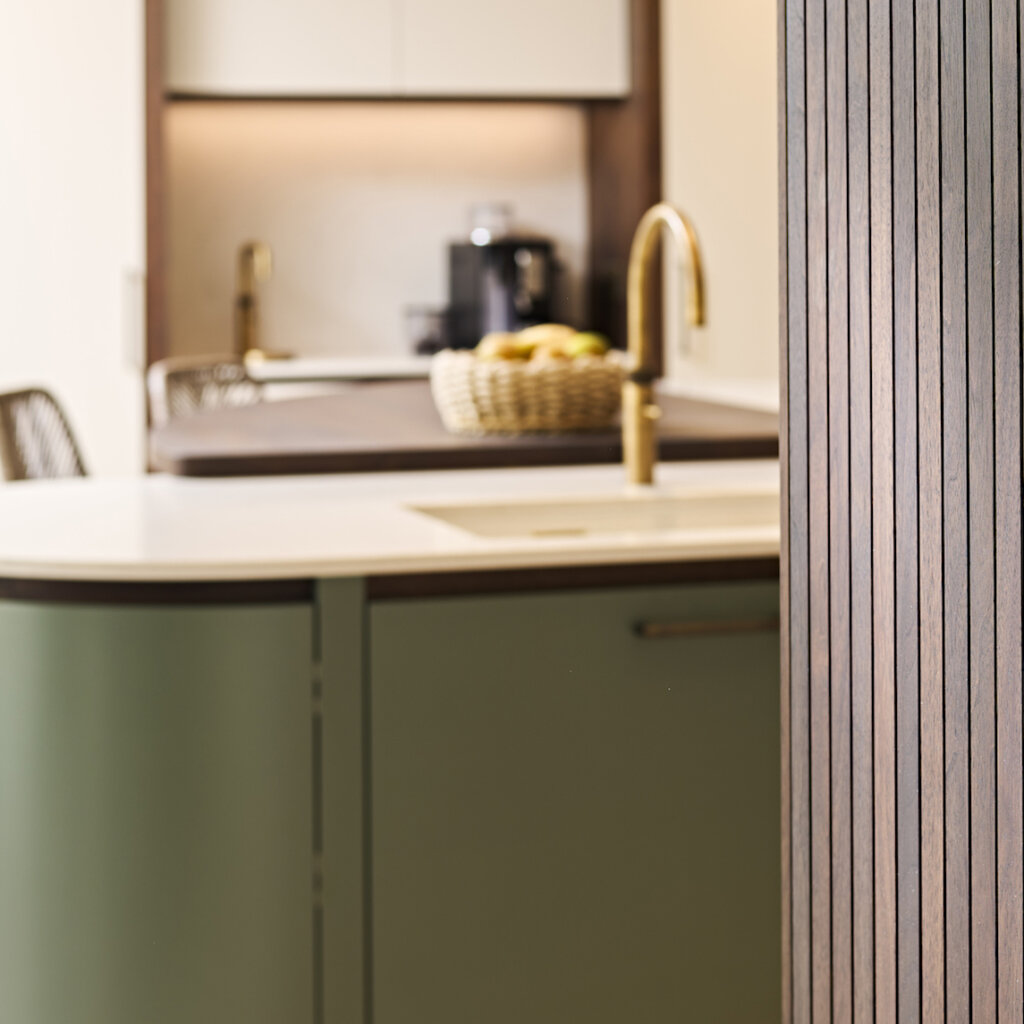
The elegant green of the island is complimented by a soft white on the wall cabinets. Both colours are based on Farrow and Ball shades: ‘Green Smoke’ and ‘Skimming Stone’ respectively. Simon was concerned however, that while the white would contribute to the lightness of the room, the cabinets might lose some definition against white walls and especially with light, reflective work surfaces. So, to counter this, he designed dark timber architectural surrounds for the painted cabinets both on the wall units and the island. This has the effect of framing the individual elements whilst at the same time visually tying the island and the wall units together, unifying them as one kitchen. The timber chosen for this was American Walnut which has been made darker using a charcoal stain which enriches the colour without losing any of the texture or character of the natural wood.
Each element of the kitchen has been designed with a specific function in mind and to create flow through the room. On entering the room from the utility room, one is invited to choose whether to sit down at the table to the left or the breakfast bar to the right, move straight through the glazed doors to the sitting room or enter the kitchen itself around one of Simon’s signature D-end cabinets on either end of the island.

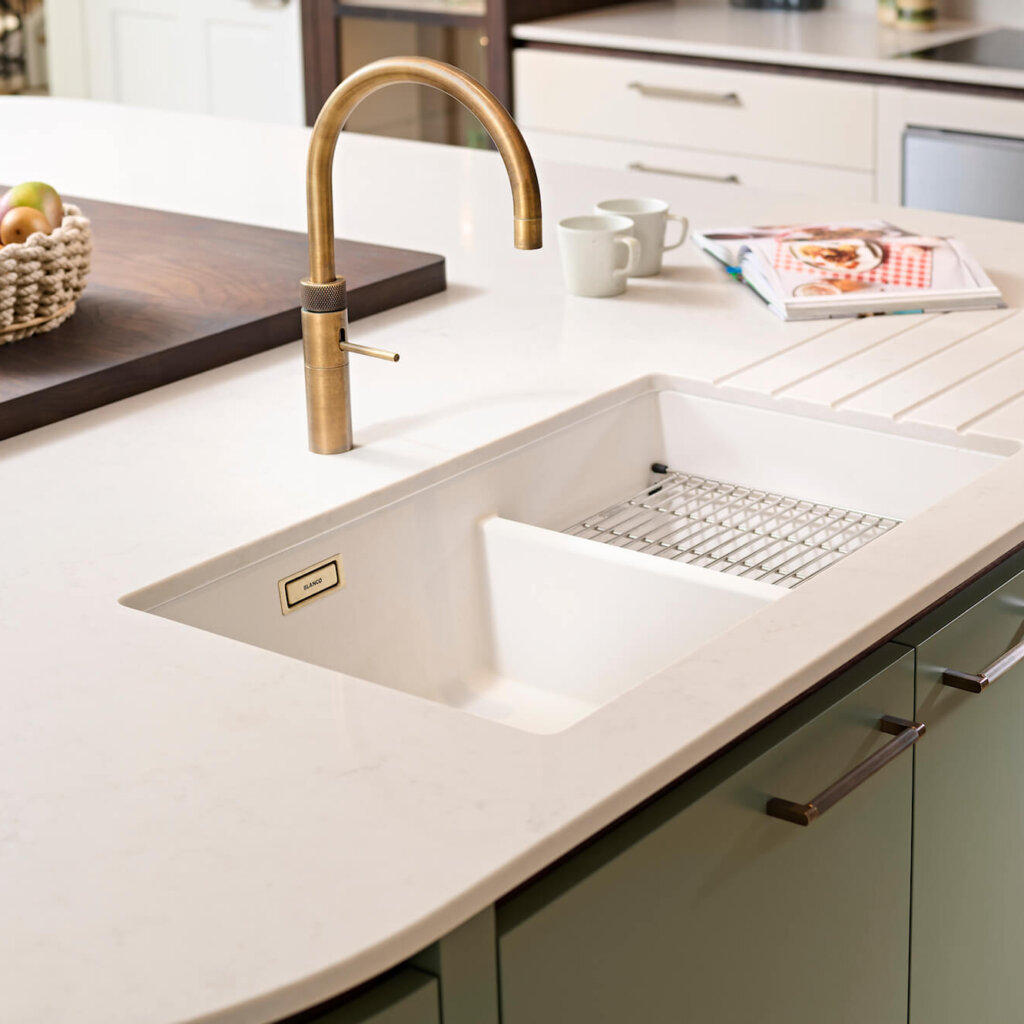
The island is itself divided into to functional areas: the walnut breakfast bar invites family or guests to socialize while a meal is prepared; while the rest of the island provides many of the services required in the preparation and serving of food. The antique brass Quooker tap and the white Blanco sink are set into the London Grey Cesarstone quartz worktop. Beneath them is a cupboard for the boiling water tank and scale filter with the integrated dishwasher set alongside, beneath the draining board. The work surface continues along the other side, with a pull-out bin store and wide drawers for crockery and cutlery, including a lift out tray which can be taken to the table thus avoiding those awkward handfuls of knives and forks.
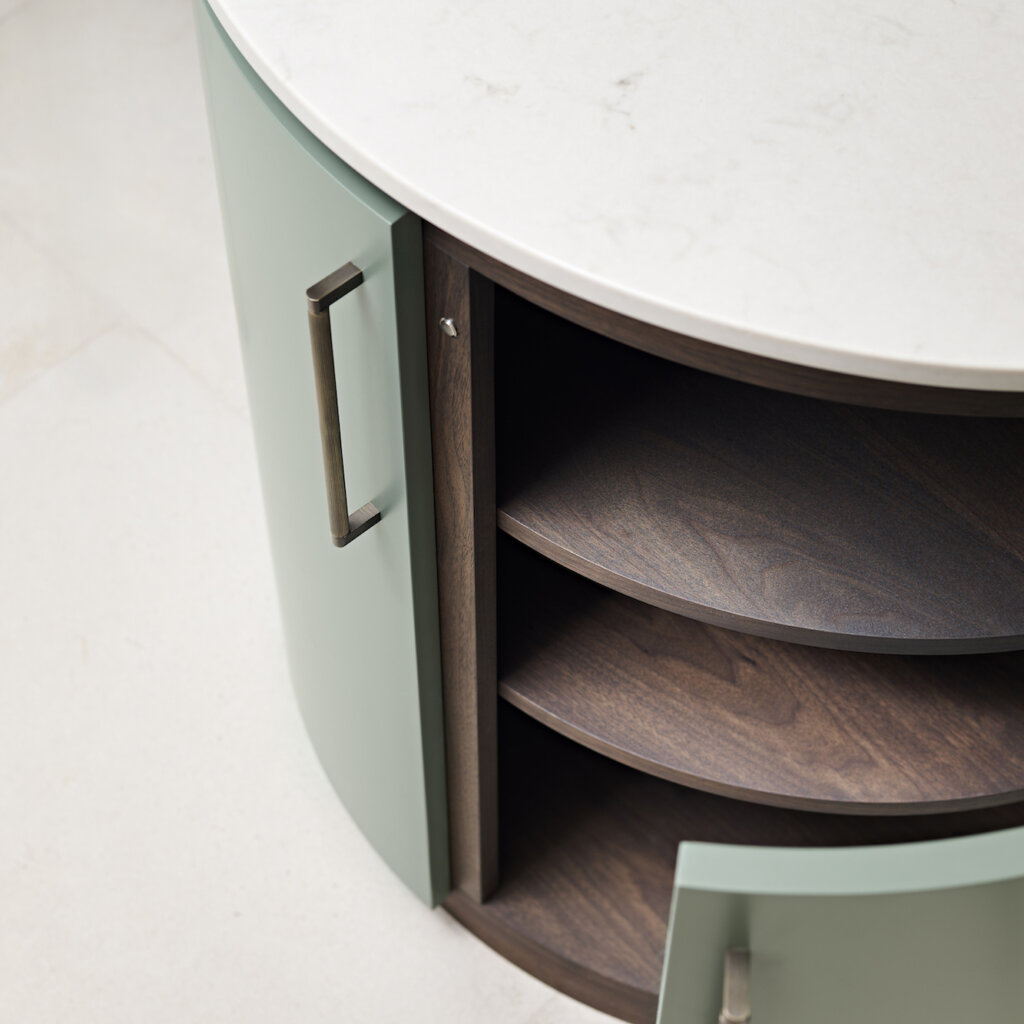
At each end of the island is a large curved fronted cupboard, ideal for storing the larger items: casserole and serving dishes, or the mixer or toaster.
Opposite the sink, the floor to ceiling cabinets run the full length of the wall and house the integrated fridge-freezer with wide single door fridge and drawer freezer below. Next to that is the slim wine fridge with storage above and the combi-microwave and steam oven stack with further storage above and below. Finally, Simon’s imaginative solution to that awkward corner: as the full height door opens, the light comes on to reveal a walk in larder complete with open shelves on three sides and more quartz worktops. Perfect for storing all the dry goods and keeping the kitchen free of any food clutter.

The principle feature of the back wall of the kitchen is the pair of glass fronted, mirror backed, illuminated display cabinets at each end. Cleverly designed to brighten the part of the kitchen furthest away from the windows, they act as columns of light, the mirrors reflecting back into the room while LEDs accentuate the sparkle of crystal and glass, all beautifully framed by that dark walnut. Between these two columns of light is the main oven and hob flanked on either side by utensil and pan drawers. Above sits a Westin extractor hidden in an eye level unit with cupboards featuring hidden recessed finger pulls to open on either side. More subtle lighting is incorporated underneath these units to provide ample task-light whilst cooking and the Cesarstone splashback provides further reflected light in this part of the room.
The final element of the kitchen itself is a dedicated hot drinks station with its own antique brass Quooker boiling water tap with self-draining drip tray and neighbouring coffee machine. The cupboard underneath the tap contains the boiling water tank and paraphernalia with more storage in the other under counter cupboard, wall cupboards and tall storage units on either side. Perfect for tea and coffee cups and full dinner services.
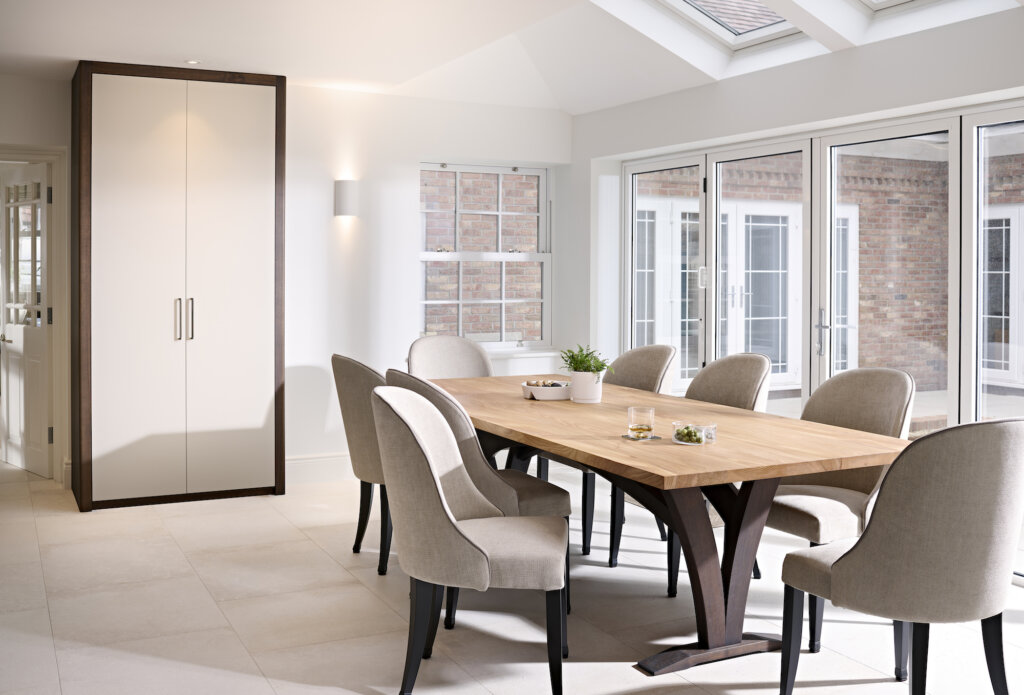
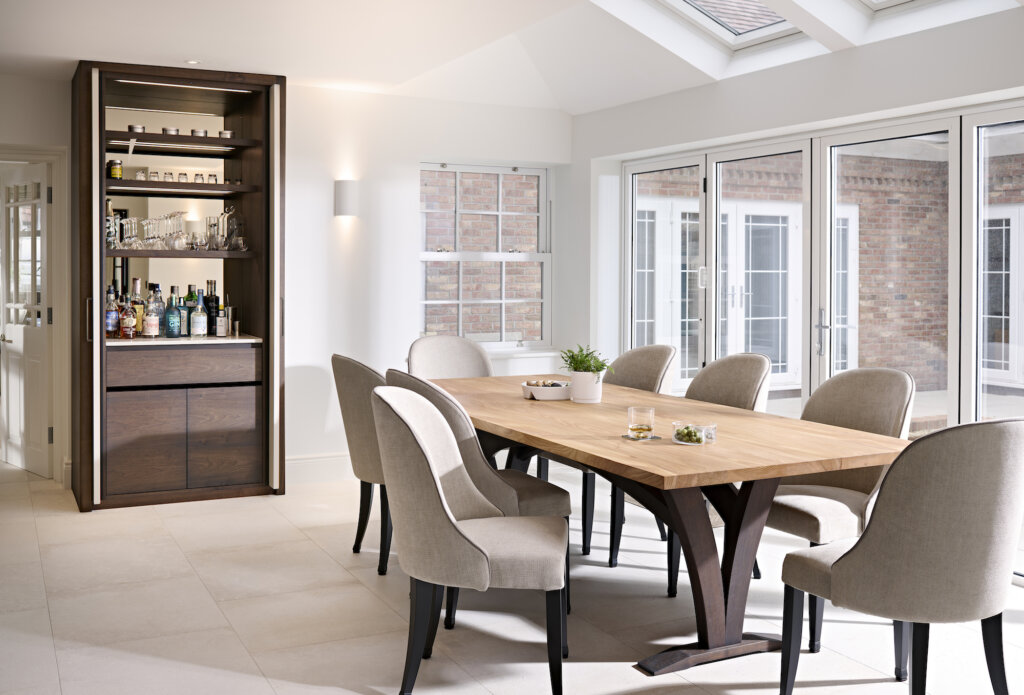
In the dining area, the clients’ own chairs surround a rectangular dining table with a richly characterful solid elm top. The under frame is constructed from the same charcoal stained American Black Walnut timber used to frame the kitchen cabinets which clearly states how it belongs in the space. At one end, next to the utility room door, stands a bar cabinet featuring pocket doors which slide back into the frame providing the client with the flexibility to have it open as a bar or shut away. The mirrored back again reflects light into the room and the whole cabinet is lit when the doors are open. Beneath the Cesarstone bar are walnut cupboards and a drawer with open display shelves above.
Throughout the kitchen and the utility room, the cupboards and drawers boast a mixture of antique brass handles from Planck and hidden recessed finger pull or push to open handles providing a sense of opulence without being fussy.

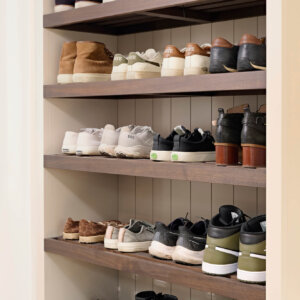
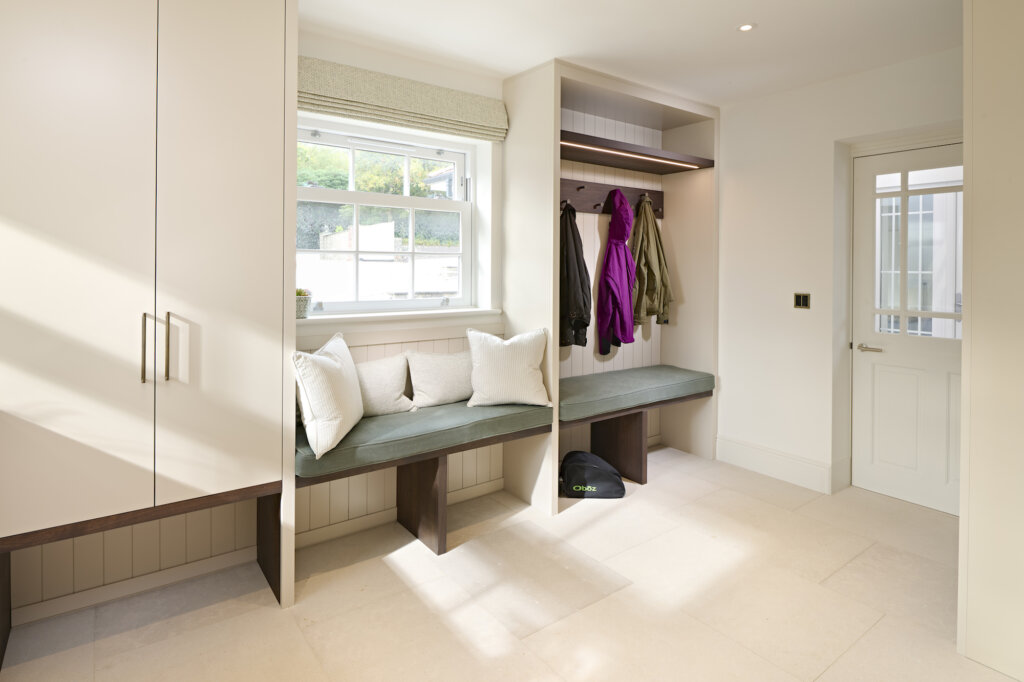
The utility room cabinetry is all painted in the same shade of white as in the kitchen and there are walnut frames along the sink unit and beneath the cupboard and seating. This provides continuity with the kitchen whilst the green is picked up in the upholstered seat cushions. Boot, shoe and coat storage is provided on either side of the door from the lobby so that wet and muddy outer- and footwear can be removed before entering the house itself. There is ample seating for the donning and removal of shoes and there is even space for the cats’ beds and feeding station underneath. Large cupboards provide more than enough storage for household bits and bobs while under counter storage is provided for washing detergent and pull out bins.
The awkward cupboard along the back of the kitchen wall contains the fuse board and other equipment but this has been redesigned to make a much more useable storage space for vacuum cleaner, brooms and mops with lighting that comes on when the door is opened. Another set of double doors conceals the heat source pump system and controls.

Overall, with the paneling above the Belfast sink, the long stretch of worktop and the cabinets carefully designed and fitted around existing door and window openings, this spacious utility room has the feeling of a back kitchen or scullery and provides an enticing hint of what more is to come as one enters the kitchen.
Appliances:
Fridge-Freezer: Gaggenau 400 series 90cm
Wine Fridge: Gaggenau 400 series 45cm
Ovens: Gaggenau 400 series 76cm main oven / steam combi / microwave combi
Hob: Gaggenau 400 series full surface induction hob
Cooker Hood: Westin Prime Slim 80cm
Taps: 2x Quooker Fusion (round and square), finish ‘Antique Brass’
Kitchen Sinks: Blanco Subline 430/270U in Silgranit
Integrated Dishwasher: Miele
Worksurfaces:
Kitchen & Utility: Caesarstone ‘London Grey’ 5000 20mm
Floor Tiles:
Handles:
Plank Hardware – ‘Becker’ in Antique Brass
Cost (inc VAT):
Kitchen cabinetry in charcoal walnut, green and off white lacquers: £90,000
Utility and coatroom cabinetry in charcoal walnut and off white lacquers: £48,000
Dining table in solid elm: £7,750
Appliances, sinks and Taps: £46,500
Worksurfaces and splash backs (both rooms): Caesarstone ‘London Grey’ 5000: £9150
Photography:
Double Exposure Photographic
written by Bridget Pirie